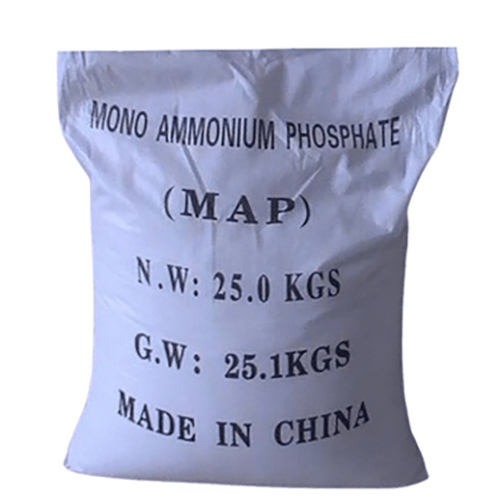
About मà¥à¤¨à¥ à¤
मà¥à¤¨à¤¿à¤¯à¤® फà¥à¤¸à¥à¤«à¥à¤
| PARAMETERS |
TEST RESULTS |
| Appearance |
White Crystal or White Crystal Powder |
| Nitrogen - N |
Min. 12% |
| Phosphorus - P2O5 |
Min 61% |
| Moisture |
Max 0.5% |
| Sodium (As a NaCl) |
Max. 0.5% |
| Water Insoluble |
Max 0.5% |
| Purity/Assay |
Min 98.5% |
| ELEMENT NAME |
STANDARD REPORT |
| Formula |
NH4H2PO4 |
| Nitrogen - N |
Min. 12% |
| Phosphorous - P2O5 |
Min. 61% |
| Moisture |
Max. 0.5% |
| Sodium (As NaCl) |
Max. 0.5% |
| NON ELEMENT NAME |
SPECIFICATION |
| Water Insoluble |
Max 0.5% |
| Purity/Assay |
Min 98.5% |
PHYSICAL ANALYSIS
| ITEM |
DESCRIPTION |
| Appearance |
White Crystal or White Crystal Powder |
| Packing |
25 Kg Bag with Inner Liner |
High Purity and Versatile ApplicationsMono Ammonium Phosphate (MAP) is known for its high purity and versatility, making it ideal for use as a fertilizer, industrial fire retardant, and food additive. Its excellent water solubility and fine granular or crystalline form allow for efficient application and uniform distribution in various environments. The product's stability and compliance with international standards ensure consistent, reliable results across multiple industries.
Outstanding Safety Profile and StorageMAP is classified as non-hazardous, non-flammable, and non-poisonous, providing a safe choice for workers and the environment. When stored in a cool, dry, well-ventilated place, it remains stable and effective for up to two years. Its odorless and slightly acidic properties make it manageable in handling and storage, meeting the requirements of technical and food-grade applications.
FAQ's of Mono Ammonium Phosphate:
Q: How is Mono Ammonium Phosphate typically used in agriculture?
A: In agriculture, MAP is primarily used as a fertilizer thanks to its high phosphorus and moderate nitrogen content. It is applied directly to soil or mixed with other nutrients to promote root development and enhance crop yields, especially in the early stages of plant growth.
Q: What benefits does MAP offer compared to other phosphate fertilizers?
A: MAP offers superior water solubility, allowing nutrients to be readily available to plants. Its slightly acidic pH helps in soils requiring acidification, and its low levels of heavy metals and impurities make it suitable for sensitive crops and food applications.
Q: When should MAP be applied to crops for optimal results?
A: The best time to apply MAP is during seedbed preparation or at the beginning of the growing season. This ensures that young plants have immediate access to phosphorus, supporting strong root development and healthy plant establishment.
Q: Where should Mono Ammonium Phosphate be stored for safety and stability?
A: MAP should be stored in a cool, dry, and well-ventilated location, away from moisture and incompatible materials. Proper storage helps maintain its stability and effectiveness throughout its two-year shelf life.
Q: What is the process for dissolving MAP for various applications?
A: MAP dissolves readily in water, with a solubility of 37 g per 100 g water at 20C. This makes it suitable for use in liquid fertilizers, foliar sprays, and industrial solutions, provided it is thoroughly mixed for uniform distribution.
Q: How does the product ensure safety during transportation and use?
A: MAP is not classified as hazardous, is non-flammable, and non-poisonous, making it safe to handle and transport. It is packaged in moisture-resistant 25 kg or 50 kg bags, or supplied in bulk, which maintains product integrity during transit.
Q: What makes MAP suitable for food industry and technical applications?
A: Due to its high purity (98%), low insoluble matter (0.1%), and compliance with food and technical standards (GB 10205-2009 / FCC), MAP is suitable for use as a food additive and in various technical processes requiring reliable, safe phosphate sources.