Customer Satisfaction Is Our Priority.


 Send Inquiry
Sodium Nitrate
MOQ : 1 Ton
Sodium Nitrate Specification
- Storage
- Store in a cool, dry, well-ventilated area, away from combustible substances
- Form
- Solid
- Ph Level
- 7 (neutral in solution)
- Poisonous
- Yes
- Melting Point
- 308 °C
- Smell
- Odorless
- Purity
- 99% min
- HS Code
- 2834.10
- Shape
- Crystalline or granular
- Solubility
- Very soluble in water, soluble in ammonia and glycerol, insoluble in alcohol
- Boiling point
- 380 °C (decomposes)
- Other Names
- Chile saltpeter, Nitratine, Soda niter
- Taste
- Saline, slightly bitter
- Molecular Formula
- NaNO3
- Density
- 2.257 Gram per cubic centimeter(g/cm3)
- Structural Formula
- NaNO3
- Molecular Weight
- 84.99 g/mol
- Classification
- Inorganic chemical
- Chemical Name
- Sodium Nitrate
- CAS No
- 7631-99-4
- EINECS No
- 231-554-3
- Grade
- Technical grade, Food grade, Industrial grade
- Standard
- Conforms to industry and food additive standards
- Type
- Inorganic salt
- Usage
- Industrial, laboratory, agriculture, food industry
- Main Material
- Sodium Nitrate
- Application
- Oxidizing agent, fertilizer, glass manufacturing, food preservative, explosives, laboratory reagents
- Incompatibility
- Combustible materials, reducing agents, strong acids
- Moisture content
- <0.5%
- Stability
- Stable under normal conditions
- Transport Information
- UN Number 1498, Hazard Class 5.1 (oxidizer)
- Packaging
- 25 kg bags or as per customer requirements
- Shelf Life
- 2 years if properly stored
- Hazard Statements
- Oxidizer, may intensify fire; Harmful if swallowed
- Appearance
- White, crystalline solid
About Sodium Nitrate
We take pride in offering our clients a premium quality assortment of sodium nitrate while keeping in mind their varied needs. This sodium nitrate is utilised as an industrial chemical, fertiliser, and food additive. Additionally, we provide these products at competitive costs.
Characteristics:
- Accurate composition
- Successful outcomes
- Extended shelf life
|
Purity |
8 % |
|
Chemical Formula |
NaNO3 |
|
Density |
2.26 g/cm3 |
|
Melting Point |
308 C |
|
Boiling Point |
380 C |
|
Molar Mass |
84.9947 g/mol |
| ITEM | Specifications | Test Results |
|
|---|---|---|---|
| Content of sodium nitrite 1/4 calculated by dry base) % | >98.5 | 99.01 | |
| Content of sodium nitrate 1/4 calculated by dry base) % | <1.0 | 0.9 | |
| Content of chloride (NaCl) 1/4 calculated by dry base) % | <0.10 | 0.07 | |
| Content of insolubles in water 1/4 calculated by dry base) % | <0.05 | 0.02 | |
| Moisture % | <1.4 | 1.0 | |
| Apperance of product |
|
||
Versatile Industrial Applications
Sodium Nitrate is employed across various sectors such as agriculture, industry, food processing, and laboratories. Its primary uses include acting as an oxidizing agent, fertilizer, glass manufacturing component, food preservative, and ingredient in explosives. Its adaptability to multiple grades-technical, food, and industrial-ensures suitability for diverse needs.
Safe Storage and Handling
To maintain stability and prevent accidents, Sodium Nitrate should be stored in a cool, dry, well-ventilated space, away from combustible materials and strong acids. The solid remains stable under normal conditions, with a shelf life of up to two years when properly stored. Proper handling practices minimize safety risks associated with its oxidizing nature.
FAQ's of Sodium Nitrate:
Q: How should Sodium Nitrate be stored to maintain its quality and safety?
A: Sodium Nitrate should be stored in a cool, dry, and well-ventilated area, separately from combustible substances, reducing agents, and strong acids. Keeping it away from moisture and incompatible materials will help maintain its stability and ensure a shelf life of up to two years.Q: What are the main uses of Sodium Nitrate in different industries?
A: Sodium Nitrate is widely used as a fertilizer in agriculture, an oxidizing agent in chemical processes, a preservative in the food industry, and a component in glass manufacturing and explosives. It is also commonly utilized as a laboratory reagent.Q: When should Sodium Nitrate be handled with particular caution?
A: Extra caution is needed when handling Sodium Nitrate near heat sources, flames, or combustible materials, as it is classified as an oxidizer and may intensify fire. Personal protective equipment should be used to prevent ingestion and contact.Q: Where does Sodium Nitrate find application in the food industry?
A: In the food industry, Sodium Nitrate is employed primarily as a preservative for cured meats and certain dairy products, helping to inhibit bacterial growth and prolong shelf life. Only food-grade Sodium Nitrate meeting regulatory standards should be used for such applications.Q: What benefits does Sodium Nitrate provide as a fertilizer?
A: Sodium Nitrate supplies essential nitrogen in a form readily absorbed by plants, promoting healthy growth and improved crop yield. Its high solubility ensures quick action when applied to soil, making it a valuable fertilizer in agriculture.Q: How is Sodium Nitrate typically packaged and transported?
A: Sodium Nitrate is commonly packed in 25 kg bags or according to customer requirements, and is classified under UN Number 1498 as a Hazard Class 5.1 oxidizer. Transportation adheres to strict regulations to ensure safe handling and to prevent incidents.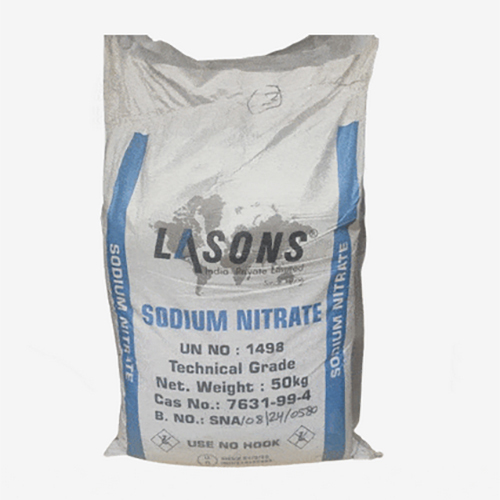
Tell us about your requirement

Price:
Quantity
Select Unit
- 50
- 100
- 200
- 250
- 500
- 1000+
Additional detail
Mobile number
Email


Contact Details
- Hemanta Basu Sarani, Trimurti Tower, 4th Floor, Unit -4B,Kolkata - 700001, West Bengal, India
- Phone : 08045816124
- Mr Pratyush Choudhary (Director)
- Mobile : 08045816124
- Send Inquiry
A.V.M. SALES PVT. LTD.
GST : 19AACCA7139H1ZL
 Send Inquiry
 Send Inquiry
 Call Me Free
A.V.M. SALES PVT. LTD.
All Rights Reserved.(Terms of Use)
Developed and Managed by Infocom Network Private Limited.
Developed and Managed by Infocom Network Private Limited.


 English
 Spanish
 French
 German
 Italian
 Chinese (Simplified)
 Japanese
 Korean
 Arabic
 Portuguese