Customer Satisfaction Is Our Priority.


 Send Inquiry
Sodium Nitrite
MOQ : 1 Ton
Sodium Nitrite Specification
- Density
- 2.168 Gram per cubic centimeter(g/cm3)
- HS Code
- 28341010
- Shape
- Crystalline, powder or granules
- Melting Point
- 271C
- Molecular Weight
- 69.00 g/mol
- Solubility
- Soluble in water, glycerol, and ammonia
- Other Names
- Nitrous acid, sodium salt
- Structural Formula
- NaNO
- Smell
- Odorless
- Poisonous
- Yes
- Purity
- Minimum 99%
- Form
- Solid
- Ph Level
- Approximately 9 (5% solution)
- Boiling point
- Decomposes before boiling
- Molecular Formula
- NaNO2
- Storage
- Store in a cool, dry, and well-ventilated place, away from heat and combustible materials
- Taste
- Slightly salty, faintly bitter
- Classification
- Inorganic Chemicals
- Chemical Name
- Sodium Nitrite
- CAS No
- 7632-00-0
- EINECS No
- 231-555-9
- Grade
- Industrial/Food Grade
- Standard
- Meets relevant industry or food safety standards
- Type
- Inorganic salt
- Usage
- Industrial, laboratory, food additive (preservative and color fixative)
- Main Material
- Sodium Nitrite
- Application
- Used in dyes, pharmaceuticals, food preservation, and water treatment
- Non Toxic
- Yes
- Shelf Life
- 2 years under proper storage
- Moisture Content
- < 1%
- Packaging Size
- Typically 25 kg bags
- Color
- White to slightly yellowish
- Incompatibility
- Avoid contact with organic materials, acids, and reducing agents
- Hazard Class
- 6.1 (Toxic substances)
- Stability
- Stable under recommended storage conditions
About Sodium Nitrite
Because of our extensive industrial experience in this field, we are able to provide our customers a huge selection of sodium nitrite of the highest quality. This sodium nitrite is used as a corrosion inhibitor and as an addition in grease production. Additionally, these products are offered to meet the various needs of our customers.
Features:
- Excellent packing
- Excellent quality
- Simple to use
|
Packaging Type |
Bag |
|
Chemical Formula |
NaNO2 |
|
Density |
2.17 g/cm3 |
|
Melting Point |
271 C |
|
Molar Mass |
68.9953 g/mol |
|
Soluble In |
Water |
| Quality Characteristics | Standard | Actual |
|---|---|---|
| Appearance | White Crystals, yellowish-grey shade | Corresponds |
| Mass fraction of Sodium Nitrite NaNO2 % Min in terms of Nitrogen | 98.5 19.7 |
98.5 19.7 |
| Mass fraction of Sodium Nitrate NaNO3 %, Max | 1.0 | 1.0 |
| Mass fraction of chlorides in terms of NaCl, % Max | 0.17 | 0.07 |
| Insoluble, % Max | 0.03 | 0.01 |
| Moisture content, % Max | 1.4 | 0.1 |
Versatile Applications Across Industries
Sodium Nitrite serves a critical role in various sectors-from preserving and color-fixing meats in the food industry to usage in dyes, pharmaceuticals, and water treatment. Its high purity and food/industrial grade versatility make it a preferred choice for manufacturers and laboratories worldwide.
Ensuring Safe Handling and Storage
Proper storage and handling are essential due to sodium nitrite's classification as a toxic substance. Store it in a cool, dry, and well-ventilated environment, away from heat, moisture, acids, organic materials, and reducing agents. Using appropriate safety measures preserves product stability and extends its usable lifespan.
FAQ's of Sodium Nitrite:
Q: How should sodium nitrite be stored to maximize its shelf life?
A: Sodium nitrite should be stored in a cool, dry, and well-ventilated area, away from sources of heat, combustible materials, acids, organic materials, and reducing agents. This prevents degradation and ensures the product remains stable for the full 2-year shelf life.Q: What are the primary industrial and laboratory uses of sodium nitrite?
A: Sodium nitrite finds extensive use in dye and pharmaceutical manufacturing, water treatment, and as a food additive for preserving and color-fixing processed meats. Its solubility and purity also make it suitable for laboratory applications requiring strict control over chemical composition.Q: When is sodium nitrite commonly used in the food industry, and what benefits does it offer?
A: In the food sector, sodium nitrite is primarily used during meat curing and processing to preserve freshness and maintain a desirable color. It also inhibits the growth of harmful bacteria, thus extending product shelf life and improving safety.Q: Where can sodium nitrite be sourced in India?
A: Sodium nitrite is available from various chemical suppliers and traders across India, typically offered in 25 kg bags suited for industrial, laboratory, or food industry needs. Reputable suppliers ensure compliance with industry and food safety standards.Q: What precautions should be taken when handling sodium nitrite?
A: Given its toxic classification (Hazard Class 6.1), handlers should use gloves, protective eyewear, and appropriate ventilation. Avoid contact with skin, ingestion, and inhalation. Keep sodium nitrite away from incompatible substances and always follow local safety regulations.Q: How does sodium nitrite function in water treatment processes?
A: Sodium nitrite acts as a corrosion inhibitor in industrial water systems, helping to prevent rust and scale buildup in pipelines and boilers by reacting with dissolved oxygen and other chemicals in the water.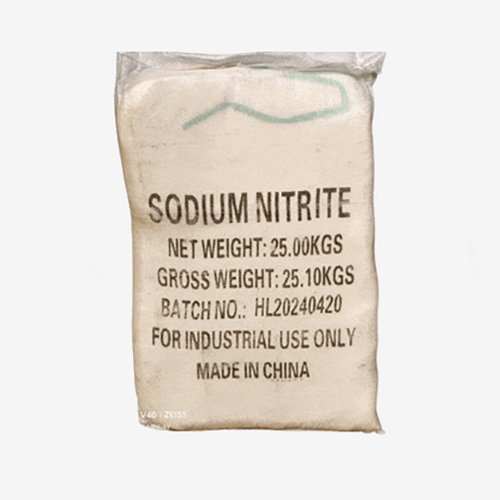
Tell us about your requirement

Price:
Quantity
Select Unit
- 50
- 100
- 200
- 250
- 500
- 1000+
Additional detail
Mobile number
Email


Contact Details
- Hemanta Basu Sarani, Trimurti Tower, 4th Floor, Unit -4B,Kolkata - 700001, West Bengal, India
- Phone : 08045816124
- Mr Pratyush Choudhary (Director)
- Mobile : 08045816124
- Send Inquiry
A.V.M. SALES PVT. LTD.
GST : 19AACCA7139H1ZL
 Send Inquiry
 Send Inquiry
A.V.M. SALES PVT. LTD.
All Rights Reserved.(Terms of Use)
Developed and Managed by Infocom Network Private Limited.
Developed and Managed by Infocom Network Private Limited.


 English
 Spanish
 French
 German
 Italian
 Chinese (Simplified)
 Japanese
 Korean
 Arabic
 Portuguese